
An underbite is one of the less common bite problems, but it can affect how you chew, how clearly you speak and how comfortable your jaw feels day to day. The good news is that it’s treatable, and there are several ways to correct one depending on your age and how pronounced it is.
This is a brief guide to treating an underbite, from braces and expanders through to surgery for the most severe cases.
What an Underbite Is
An underbite develops when the lower teeth sit in front of the upper teeth instead of behind them. It’s the opposite of an overbite, where the upper teeth extend too far out over the lower ones.
Underbites are often inherited. They’re also common in people born with a cleft lip or palate. Less often, an underbite results from an injury or from a thumb sucking habit that carried on past early childhood.
Plenty of people live with a mild underbite and never notice much beyond how it looks. A more pronounced one can make it harder to chew and to speak clearly, and it can put uneven strain on the jaw joint over time.
Before your appointment, it helps to make a note of what you’ve been experiencing. Persistent jaw pain, clicking, or difficulty biting through food are all worth bringing up. Pay attention to your resting tongue position too. When your mouth is closed and relaxed, your tongue should rest against the roof of your mouth. A tongue that habitually sits low against the lower jaw can influence how the upper jaw develops in a growing child.
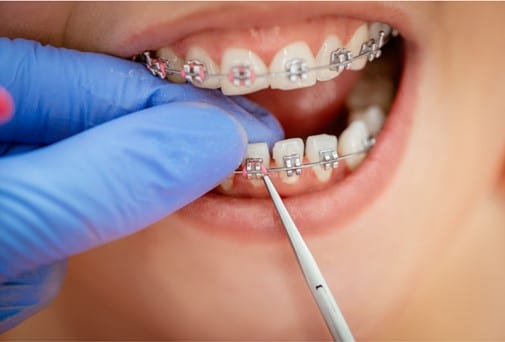
Underbite Braces
Braces are the most common way an underbite gets corrected. They straighten teeth that have shifted around the bad bite, and with the right additional hardware they can change how the upper and lower jaws meet.
Underbite braces work the same way as any other braces. Your orthodontist may add elastics running between the upper and lower arches to gradually bring the lower jaw back into a better relationship with the upper one.
Dr. Ravi Rajanna adjusts the wires as the teeth and jaw move, taking digital scans and X-rays along the way to confirm everything is tracking the way it should. For most adults, braces are the strongest option short of surgery. How long treatment runs depends on the case, and a mild underbite generally resolves faster than a complex one.
You’ll need to adjust what you eat while you’re in treatment. Anything hard, sticky, or chewy enough to break a bracket comes off the menu until your braces do.
If you’d rather not have visible hardware, clear aligners can handle many mild to moderate underbite cases. More pronounced ones usually call for braces or a combination of approaches.
Non-Surgical Treatment for Underbite
Several non-surgical options are available, and a long-term correction sometimes needs two or more of them working together. Which ones fit depends heavily on age, because the most effective window is while a child is still growing.
Palate and Jaw Expanders
When the upper jaw hasn’t developed to its full width, an expander can help. Your orthodontist fits a metal appliance across the upper back teeth, and it gradually widens the palate and upper jaw over a period of months.
Some expanders work like a removable retainer. Others are fixed to the palate and stay put through the active phase. Expanders work best in younger children, because the bones of the palate don’t fully fuse until around age 12 or 13. That’s a large part of why an early orthodontic evaluation matters so much for a developing underbite.
Expanders are typically worn for around a year, and a retainer often follows to hold the result while the bones settle.
Headgear and Chin Cups
Headgear is the other appliance used to correct a growing underbite. It rests against the forehead, and your orthodontist connects it to the braces with elastic bands. Over time it guides the upper jaw forward into a better position.
Some designs use a chin cup instead, working on the lower jaw. Headgear is most effective in children around age ten or younger. It can be worn during the day and overnight, and it comes off easily for school or a social event.
Surgical Treatment for Underbite
When a severe underbite is skeletal rather than dental, surgery becomes part of the plan. This comes up most often in adults, whose jaw growth is complete and can’t be guided the way a child’s can.
Extractions are sometimes needed first, if there are more teeth than the upper jaw has room for. Removing one or two creates the space the braces need to work with.
Orthognathic surgery itself is handled by an oral and maxillofacial surgeon working alongside your orthodontist. Depending on the case, the surgeon repositions the upper jaw, the lower jaw, or both, then secures the bone with small plates or screws so it holds where it’s been moved to. Some cases need bone grafted from elsewhere, and the full course can run across a year or more with orthodontic work on either side of the procedure.
The incisions are made inside the mouth, so the surgery doesn’t leave visible scarring. Your surgeon will walk you through recovery and what to expect in the weeks afterward.
Getting Your Underbite Treated
An underbite is worth taking seriously if it’s affecting how you eat, how you speak, or how your jaw feels. A mild one may need nothing beyond monitoring. A pronounced one has real options behind it at every age, from expanders and headgear in childhood through to braces, clear aligners, and surgery in the most severe cases.
At Lakewood Orthodontics in Lee’s Summit, we treat every patient like part of the family. Our goal is healthy smiles that last, delivered with modern orthodontic care in a relaxed, family-friendly setting. We offer traditional braces, clear ceramic braces, hidden braces, and clear aligners, so there’s an option that suits how you want to go through treatment.
Schedule your free consultation and we’ll take a look at what’s going on and talk through what would work best for you.